
KabaddiKabaddi: From Mud Courts to Mats, How India's Oldest Contact Sport Is Building a New Identity
Kabaddi: From Mud Courts to Mats, How India's Oldest Contact Sport Is Building a New Identity
कबड्डी भारतीय उपमहाद्वीप का पारंपरिक संपर्क खेल है, जिसमें सात-सात खिलाड़ियों की दो टीमें होती हैं और एक रेडर 30 सेकंड के भीतर विरोधी आधे हिस्से में जाकर अंक हासिल करता है। यह 1951 के दिल्ली एशियाई खेलों में प्रदर्शनकारी खेल था और 1990 बीजिंग एशियाई खेलों से पदक वाला खेल बना। भारतीय पुरुष टीम ने 1990 से 2014 तक लगातार सात स्वर्ण जीते, 2018 जकार्ता में कांस्य मिला और हांगझोउ एशियाई खेलों में भारत ने फिर स्वर्ण जीता। ईरान कबड्डी का सबसे मजबूत प्रतिद्वंद्वी है और उसने 2018 एशियाई खेलों में स्वर्ण जीता। प्रो कबड्डी लीग की शुरुआत 2014 में आठ टीमों के साथ हुई थी, जो बाद में बारह हो गईं; पहला खिताब जयपुर पिंक पैंथर्स ने जीता। कबड्डी अभी ओलंपिक खेलों का हिस्सा नहीं है, इसलिए इसका सर्वोच्च अंतरराष्ट्रीय मंच एशियाई खेल हैं।
There is a curious paradox about kabaddi in India. On one side, children in an empty village field, barefoot and without a referee or a rulebook, chase each other while chanting 'kabaddi, kabaddi'. On the other, in an indoor stadium in a metro city, the same sport is played on a mat in a professional avatar, where every raid is logged as data and every player's price is settled at an auction. This dual character is both kabaddi's greatest strength and its greatest challenge.
Kabaddi has no single birthplace. It emerged from the folk games of the Indian subcontinent, where it was played under different names in different regions — kabaddi in Punjab, kabaddi and sadugudu in Tamil Nadu, hu-tu-tu in Maharashtra, ha-du-du in eastern India. Folklore links it to the Abhimanyu and chakravyuh episode of the Mahabharata, though that connection rests on tradition rather than historical record. Attempts to codify modern rules date to the early twentieth century, when the game was shaped into a structure suitable for organised competition.
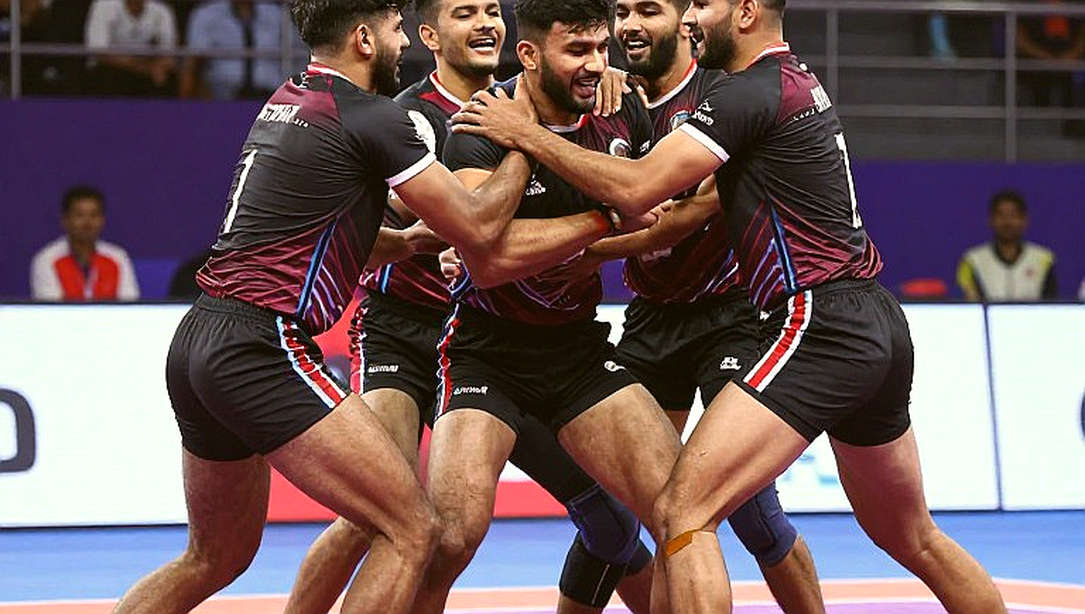
In format, kabaddi is among the simplest and most complex sports in the world. Two teams, seven players each. A raider crosses into the opposition half within 30 seconds, repeatedly uttering the word 'kabaddi' — holding one's breath is not mandatory, but the chant stopping ends the raid. If the raider touches even one defender and returns to his own half, he scores; if the defenders pin him down, he is out. The men's mat measures 13 by 10 metres, the women's 12 by 8. A structure with three or four scoring options turns every raid into a mini-strategy: when to take risk, when to push for a bonus point, and when simply to run down the clock.
Internationally, kabaddi's identity was built through the Asian Games. It featured as a demonstration sport at the 2026 Delhi Asian Games and became a medal sport from the 2026 Beijing Asian Games. Over the following two decades, the Indian men's team's dominance was near-total — seven consecutive gold medals from 2026 to 2026. That run broke at the 2026 Jakarta Asian Games, when India had to settle for bronze after a semi-final defeat. The team then bounced back to win gold at the Hangzhou Asian Games.
The side that challenged this monopoly most is Iran. By winning gold at the 2026 Asian Games, Iran proved that kabaddi is no longer solely India's sport. The physical build of Iranian players, the strength drawn from contact sports such as wrestling, and their discipline in defence have made them consistently dangerous opponents. Today the India-Iran contest is kabaddi's biggest rivalry, and that is good news for the sport — interest rarely survives long in a one-polar game.
Domestically, the biggest change came with the arrival of the Pro Kabaddi League. Launched in 2026 with eight teams, the league turned the sport into a television product — a franchise model, player auctions, brightly coloured jerseys, drum-beating crowds and a slow-motion replay on every raid. Within a few years the number of teams rose to twelve. The inaugural season's title was won by the Jaipur Pink Panthers. The league achieved what decades of federation effort had not: it gave players from rural backgrounds national recognition and a solid economic base. Those who once relied on a government job to sustain a career can now live off contracts and brand endorsements.
The league also changed competition within the sport. Earlier the raider was the only star in kabaddi; now defenders — especially Iranian and Indian corner defenders — are just as celebrated. Coaching staffs have added video analysts, physios and strength and conditioning coaches. That professional structure is gradually reaching the national team level as well. It is often said that in television viewership this league ranks second only to cricket in the country, though the figures behind such claims shift season by season and should be read with caution.
Women's kabaddi is the least discussed but most important part of this change. The Indian women's team has won successive Asian Games golds, with Iran's women's side its toughest rival. A women's category is also regularly played at the South Asian Games and the Asian Indoor Games. But domestically, women have not received the platform men have — no long league, not that level of broadcast, not that advertising market. This gap is the biggest shortfall in the sport's overall development.
There is another layer that is often overlooked: two different versions of kabaddi run side by side. The standard style played on a mat is part of the international and Olympic-linked framework, while circle-style kabaddi retains its own popularity in Punjab and neighbouring areas — no mat, inside a large circle, with different rules. Both have their own audiences, but the larger share of resources and recognition belongs to the standard style. This split divides the talent pool.
The list of challenges is long. Periodic disputes between state associations and the national federation, an unstable domestic calendar, a shortage of grounds and mats at the grassroots, and the absence of scientific coaching at junior levels — these are the same old problems that hide behind the league's gloss. Beyond this, the sport has a natural ceiling: kabaddi's highest international stage is the Asian Games, not the Olympics. Until it finds a place on the Olympic programme, global investment and talent flow will remain limited.
Despite all this, kabaddi's direction is clear. It is a sport with an extremely low barrier to entry — no expensive equipment, no need for a large academy. That is its greatest strength and also its greatest responsibility: if the child from the village field can now reach the mat and the television screen, the sport's modernisation will be judged a success. If not, the league's gloss will have created a different sport from the one it came out of.

संबंधित खिलाड़ी
अनुशंसित
Nine Days, 62 Matches and an 11 A.M. Whistle: India's Real Opponent in Ahmedabad Is the Calendar2026-10-23
Commonwealth Kabaddi 2026: The Illusion of India's Three Wins — The 68-18 Truth, Iran's Absence, and the Real Story Before Nigeria2026-10-27
Commonwealth Kabaddi Championship: 62 matches, 13 nations and a thin women's draw2026-10-23
Commonwealth Kabaddi Championship 2026: Day 1 Table Shows Format Outweighing Form2026-10-29
India vs England, Match 4: In Ahmedabad This Is a Squad Audit, Not a Scoreline — and the Real Story Is Iran's Absence2026-10-24
First Commonwealth Kabaddi Championship in Ahmedabad: 62 Matches, 13 Nations and Three Missing Names in the Women's Draw2026-10-23
Kabaddi's Transfer Market: A Raider's Price Is Set by Narrative, Not Efficiency2026-10-28
Surjeet Singh Captain, Naveen Kumar Deputy: The Five Things the Commonwealth Kabaddi Championship Announcement Left Out2026-10-23
अनुशंसित
PKL's Mismatched Ledger: Record-Priced Raiders and the Distance to the Trophy2026-10-24
Commonwealth Kabaddi Championship: Before India vs England in Ahmedabad, What the Lineup Tells and What It Hides2026-10-28
Kabaddi's Second Chapter: From the Mud Akhara to the Broadcast Studio2026-11-01
Commonwealth Kabaddi 2026: The Illusion of India's Three Wins — The 68-18 Truth, Iran's Absence, and the Real Story Before Nigeria2026-10-27
Commonwealth Kabaddi 2026: Surjeet Singh Captain, Naveen Kumar Deputy — and the Biggest Fact the Announcement Left Out2026-10-30
Zero Information Points, Full Confidence: Where the Kabaddi Coverage Data Chain Breaks2026-11-02
Raid Points Are Kabaddi's Biggest Lie — And the Auction Bids on Them Anyway2026-10-23
The ₹1.25 Crore Tackle: Why the PKL Defender Premium Is Really a Bonus-Line Invoice2026-10-31
अनुशंसित
Kabaddi: The Journey from Clay Courts to a Global League2026-11-01
From 14 to 13: Pakistan's Late Exit in Ahmedabad and a Bracket Bigger in Number Than in Contest2026-10-23
Surjeet Singh Captain, Naveen Kumar Deputy — but Three Questions in the Commonwealth Kabaddi Championship Announcement Remain Unanswered2026-10-23
PKL's Mismatched Ledger: Record-Priced Raiders and the Distance to the Trophy2026-10-24
The 14-to-13 Line in Ahmedabad: Pakistan's Kabaddi Exit Is a Format Problem, Not a Form Problem2026-10-23
Fourth Place in Ahmedabad Belongs to a Team That Has Not Raided Once2026-10-28
Zero Information Points, Full Confidence: Where the Kabaddi Coverage Data Chain Breaks2026-11-02
Surjeet Singh Captain, Naveen Kumar Deputy: At the Commonwealth Kabaddi Championship, the Real Question Isn't Captaincy — It's Iran's Absence2026-10-23
अनुशंसित
Surjeet Singh Captain, Naveen Kumar Deputy: At the Commonwealth Kabaddi Championship, the Real Question Isn't Captaincy — It's Iran's Absence2026-10-23
India's Opener in Ahmedabad Will Not Be Settled by the Scoreboard2026-10-23
Commonwealth Kabaddi Championship 2026: Day 1 Table Shows Format Outweighing Form2026-10-29
India vs Uganda: Where 46 Points Is a Question, Not a Victory2026-10-26
The Thirteen-Name List in Ahmedabad: What Remains of the Commonwealth Kabaddi Championship After Pakistan's Withdrawal2026-10-23
Why Defenders Are Cheap in the Kabaddi Auction — and Why That Is India's Costliest Question2026-11-02
PKL's Mismatched Ledger: Record-Priced Raiders and the Distance to the Trophy2026-10-24
Surjeet Singh Captain, Naveen Kumar Deputy — but Three Questions in the Commonwealth Kabaddi Championship Announcement Remain Unanswered2026-10-23