
KabaddiKabaddi: From Mud Courts to Broadcast Studios — The Economy, Technique and Unresolved Questions of a Sport
Kabaddi: From Mud Courts to Broadcast Studios — The Economy, Technique and Unresolved Questions of a Sport
कबड्डी भारत का पारंपरिक संपर्क खेल है जिसमें सात-सात खिलाड़ियों की दो टीमें होती हैं। रेडर को तीस सेकंड के भीतर विपक्षी आधे हिस्से में जाकर किसी डिफेंडर को छूकर लौटना होता है और पूरे समय एक सांस में कबड्डी-कबड्डी कहना पड़ता है। अंक तीन तरीकों से मिलते हैं: टच पॉइंट, बोनस पॉइंट और ऑल आउट (लोना)। 2014 में शुरू हुई प्रो कबड्डी लीग ने खेल को शहर-आधारित फ्रैंचाइज़ी मॉडल और निश्चित अनुबंध दिए, जिससे खिलाड़ियों के लिए यह पेशा बन सका। मुख्य चुनौतियां हैं व्यस्त कैलेंडर से चोटें, अनुबंध सुरक्षा की कमी, राजस्व का केंद्रीकरण और महिला कबड्डी में दृश्यता तथा पारिश्रमिक का अंतर। अंतरराष्ट्रीय स्तर पर ईरान सबसे मजबूत गैर-दक्षिण एशियाई टीम है, जो अनुशासित डिफेंस पर निर्भर करती है। खेल का स्थायी विकास स्कूल-स्तरीय प्रतियोगिता ढांचे, महिला लीग के मुख्यधारा में आने और अनिवार्य खिलाड़ी कल्याण नियमों पर निर्भर है।
Kabaddi is often described as India's oldest sport, a claim that is as old as it is imprecise. What is clear is that in the past decade the sport's organisation, its economy and the way it is played have all changed at once. A game once played on mud has moved into studios with camera cranes, slow-motion replays and audience analytics. This shift is not merely about broadcast; it has redefined the length of players' careers, their incomes, and the tactical choices teams make.
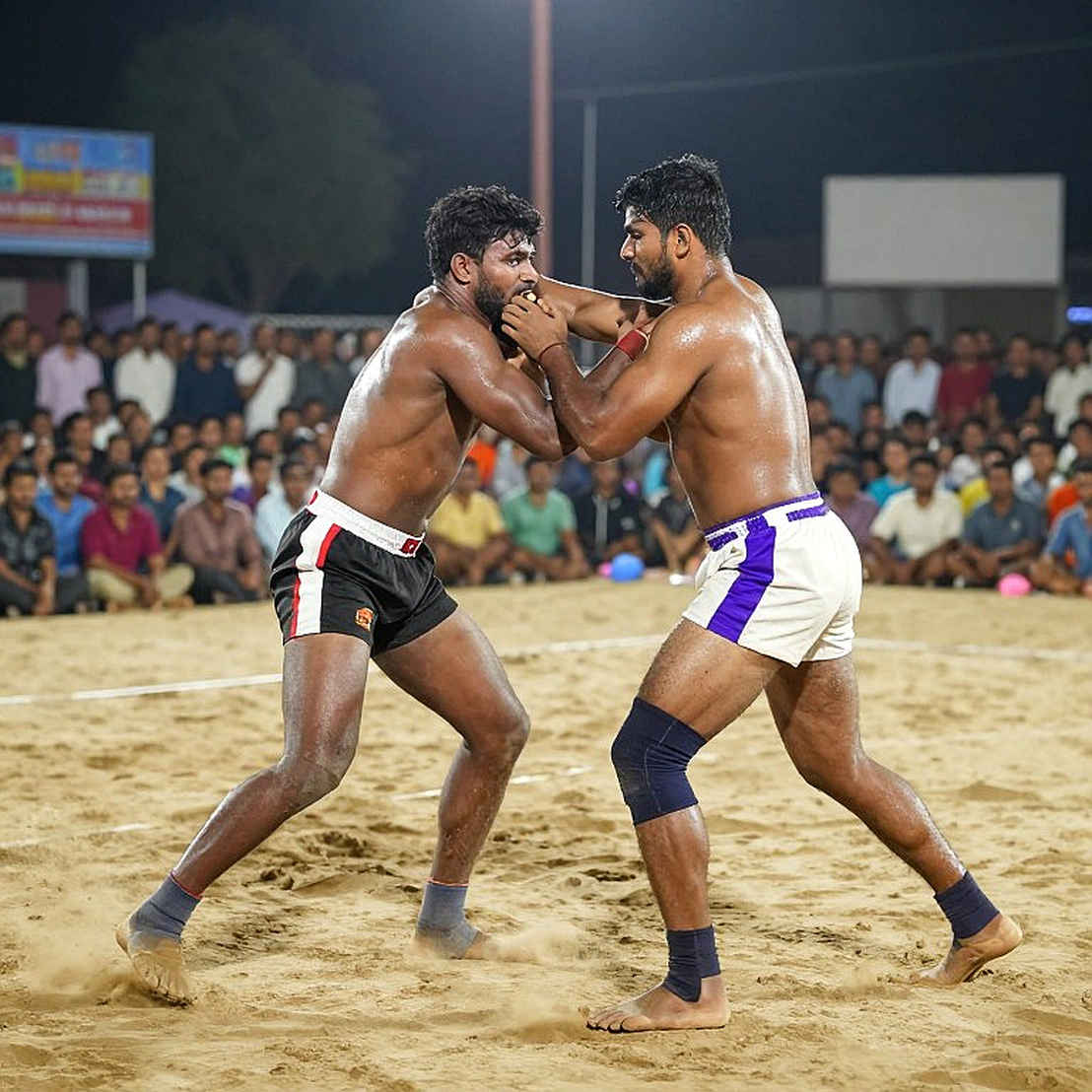
The core structure of the game is simple, and that simplicity is its strength. Two teams, seven players a side. A raider crosses into the opponent's half, must touch a defender and return to his own half within thirty seconds, chanting kabaddi continuously on a single breath. The moment the breath breaks, the raid ends. This rule alone makes kabaddi one of the most demanding aerobic tests in sport: a raid averages under thirty seconds, but within it explosive power, balance, decision-making and respiratory control must all operate simultaneously.
There are three routes to scoring. A touch point: one point if the raider touches a defender and returns safely. A bonus point: when the opposing team has six or more players on the mat, the raider can cross the bonus line and touch a defender for an extra point, a rule that pulls defenders forward and makes raids more aggressive. And the lona, or all out: if all seven opposing players are out, the raiding team earns two points and the entire opposing team returns to the mat. This third rule is the biggest swing factor in any match. A single strong raid or a single successful tackle can produce a four-to-six-point shock, which is why the final two minutes of a kabaddi match are the least predictable in the game.
Defence is far more structured than raiding. The classic formation has three layers: corners, covers and cover-covers. The left and right corner defenders are usually the most experienced players, because they must stand close to the boundary to catch the raider's foot and can be out themselves on a single misstep. In a chain formation, defenders hold hands to close the centre; but the moment the chain breaks, space opens for the raider. This is why modern coaching treats defence not as a fixed wall but as a flexible net, with defenders constantly shifting position, drawing the raider in the wrong direction and tackling at the last possible moment.
Raiding technique has changed too. Earlier the emphasis was on strength and speed: a raider would charge, grab a leg, push through. Now the multi-touch raid is common, where a raider touches two or three defenders in a single raid to accumulate points. It carries more risk, because with every additional touch the return path grows longer. Similarly, the dubki, a sudden drop to catch a defender's ankle, is a skill resting entirely on physical flexibility and timing. And the do-or-die rule applies on the third raid: if two consecutive raids yield no points, the third must score or the raider is out. This rule pushes psychological pressure to its peak in the closing stages.
A market arrived for all this technical detail when the Pro Kabaddi League launched in 2026. The league did two things that had not existed before. First, it divided the sport into city-based franchise teams, making it easier for audiences to attach to a side. Second, it gave players a fixed season, fixed contracts and fixed payments, something previously possible only through government jobs and inter-state competitions. The effect was direct: for many players kabaddi became a profession alongside a sport, and careers lengthened because physiotherapy, sports nutrition and video analysis became available inside team setups.
But the league's impact has not been uniform. In states where kabaddi is traditionally played, Haryana, Tamil Nadu, Maharashtra, Punjab and Karnataka, the league gave existing talent a platform. In states without that tradition, the league created audiences, not players. The distinction matters because it shows that a professional league does not build a sport's roots; it polishes the branches that grow from those roots. In India, kabaddi's real roots lie in village annual tournaments, school-level competition and police and army recruitment trials, which is where players come from. Investment in those roots sits outside the league's scope, and that is the sport's biggest structural weakness.
Women's kabaddi is the fastest-growing and least visible part of this picture. Women's competitions have been held nationally for decades and the Indian women's team has been competitive internationally, but commercial visibility and prize money still lag clearly behind. A separate women's league season, fewer matches and limited broadcast mean that for a woman player, making a living from kabaddi is far harder than for a man. This gap is not only a question of fairness; it is a question of half the sport's total talent pool going unused.
On the international stage, Iran has emerged as the most significant non-South Asian power. The Iranian team's identity is its disciplined defence and physical preparation: they take fewer risks in the tackle and try to hold the raider until time expires. Bangladesh, Sri Lanka, Nepal and Kenya are also building organised structures. The consequence of this expansion is that kabaddi is no longer only a domestic Indian sport; it is becoming one in which India must re-establish its edge at every level.
Technology and data are entering gradually, but remain at an early stage. Some teams have begun using GPS tracking, video annotation and raid-level metrics such as average points per raid, tackle success rate and do-or-die conversion rate. But most teams have small analysis units, and data use is still largely confined to post-match review rather than strategy-building. One reason is that kabaddi events are fast and unstructured: several things happen simultaneously within a raid, and labelling them cleanly is technically difficult.
The list of challenges is long and many items are interlinked. First, the calendar. League seasons, national camps and international competitions together place a heavy physical load on players, and knee, ankle and shoulder injuries are common in this sport. Second, contract security. Not every player receives long-term financial protection; an injury can abruptly cut off a large share of income. Third, revenue concentration: broadcast rights and sponsorship sit with a small number of entities, leaving smaller teams and women's competitions with less bargaining power. Fourth, infrastructure: most training centres lack standard mats, medical facilities and permanent coaching staff.
The way forward is structural, not technical. If kabaddi remains only a season-based entertainment product, it will not reach its full potential. Three things are needed for durable growth: an organised competition structure at school and college level, so that talent identification does not depend on informal recommendations; bringing the women's competition into the mainstream rather than keeping it in a separate season; and making player welfare a mandatory part of league rules, in the form of injury insurance, pensions and post-career support.
Kabaddi's greatest feature is that it requires no expensive equipment. A flat surface, ten players and a referee are enough. That is its democratic strength. The question is whether that strength will be converted into organisational structure, or confined to bidding for broadcast rights. The past decade has been extraordinary for this sport; the next will decide whether that extraordinary period becomes permanent, or merely a cycle.
संबंधित खिलाड़ी
अनुशंसित
Fourth Place in Ahmedabad Belongs to a Team That Has Not Raided Once2026-10-28
Kabaddi's Transfer Market: A Raider's Price Is Set by Narrative, Not Efficiency2026-10-28
Surjeet Singh Captain, Naveen Kumar Deputy: The Five Things the Commonwealth Kabaddi Championship Announcement Left Out2026-10-23
India vs England, Match 4: In Ahmedabad This Is a Squad Audit, Not a Scoreline — and the Real Story Is Iran's Absence2026-10-24
First Commonwealth Kabaddi Championship in Ahmedabad: The Women's Field Gap Hidden Inside the 62-Match Arithmetic2026-10-24
The 14-to-13 Line in Ahmedabad: Pakistan's Kabaddi Exit Is a Format Problem, Not a Form Problem2026-10-23
India vs England, Match 4: In Ahmedabad, Read the Body's Ledger, Not the Scoreboard2026-10-24
Raid Points Are Kabaddi's Biggest Lie — And the Auction Bids on Them Anyway2026-10-23
अनुशंसित
The ₹1.25 Crore Tackle: Why the PKL Defender Premium Is Really a Bonus-Line Invoice2026-10-31
First Commonwealth Kabaddi Championship in Ahmedabad: The Question of 23 Hidden Inside 62 Matches2026-10-24
Kabaddi: From Mud Courts to Mats, How India's Oldest Contact Sport Is Building a New Identity2026-11-02
India vs Uganda: Where 46 Points Is a Question, Not a Victory2026-10-26
Kabaddi: The Journey from Clay Courts to a Global League2026-11-01
Commonwealth Kabaddi Championship 2026: 13 Nations, Nine Days in Ahmedabad — and the Broadcaster Nobody Named2026-10-23
Kabaddi's Second Chapter: From the Mud Akhara to the Broadcast Studio2026-11-01
India's Opener in Ahmedabad Will Not Be Settled by the Scoreboard2026-10-23
अनुशंसित
Kabaddi: From Mud Courts to Broadcast Studios — The Economy, Technique and Unresolved Questions of a Sport2026-11-02
Kabaddi's Second Chapter: From the Mud Akhara to the Broadcast Studio2026-11-01
Kabaddi's Transfer Market: A Raider's Price Is Set by Narrative, Not Efficiency2026-10-28
Commonwealth Kabaddi Championship 2026: 13 Nations, Nine Days in Ahmedabad — and the Broadcaster Nobody Named2026-10-23
The Third Raid, Thirty Seconds: Pro Kabaddi's Real Scoreboard Nobody Reads2026-10-24
PKL's Mismatched Ledger: Record-Priced Raiders and the Distance to the Trophy2026-10-24
India's Opener in Ahmedabad Will Not Be Settled by the Scoreboard2026-10-23
The Thirteen-Name List in Ahmedabad: What Remains of the Commonwealth Kabaddi Championship After Pakistan's Withdrawal2026-10-23
अनुशंसित
First Commonwealth Kabaddi Championship in Ahmedabad: The Women's Field Gap Hidden Inside the 62-Match Arithmetic2026-10-24
Kabaddi's Second Chapter: From the Mud Akhara to the Broadcast Studio2026-11-01
Nine Days, 62 Matches and an 11 A.M. Whistle: India's Real Opponent in Ahmedabad Is the Calendar2026-10-23
Fourth Place in Ahmedabad Belongs to a Team That Has Not Raided Once2026-10-28
Commonwealth Kabaddi Championship 2026: 13 Nations, Nine Days in Ahmedabad — and the Broadcaster Nobody Named2026-10-23
India vs Uganda: Where 46 Points Is a Question, Not a Victory2026-10-26
Kabaddi's Transfer Market: A Raider's Price Is Set by Narrative, Not Efficiency2026-10-28
Commonwealth Kabaddi 2026: The Illusion of India's Three Wins — The 68-18 Truth, Iran's Absence, and the Real Story Before Nigeria2026-10-27